
Thinking linearly vs. exponentially

Happy Monday, friends!
This is probably one of the better posts I have written (according to myself). It is a series of life thoughts about investing, success, and how to live a happy life.
But first, how is your week holding up? Did you survive after the brutal Monday crash 1 week ago?
I’ve talked to a lot of people, and a surprising number of people have gotten rekt.
A huge problem with many crypto people is that they apply the Martingale strategy (without even knowing it), and think that it will make them win in the end.
You buy the dip, then it dips more so you increase your bet, it dips again and you deploy even more, then damn it dips again and you deploy your last dollars. To your surprise, there’s another dip and even though you have low leverage (3-5x), you can get wiped out completely.
$ETH dropped 17% in 4 minutes on the Monday 1 week ago.
Now do the math if you had a 5x leverage on that position.
Thinking linearly vs. exponentially

If you put in x amount of hours, you will earn y amount of money, and produce z amount of a product/service.
Well, at least this is how most people think. They think linearly.
But is it the right way to think?
If you apply leverage and time you get compound interest. The results you produce will add to the existing layer.
If you take 10 + 10 + 10 + 10 + 10 + 10 + 10 + 10 + 10, you’ll easily see that it is 90.
But if I ask you to calculate a 10% interest rate on an investment over 40 years, most people would think that you’ll just add 10% + 10%..forty times and get 400%.
But the answer is not 400%.
The answer is: 4,525%.
Which means a $100k investment turns into $4,525,000 over 40 years.
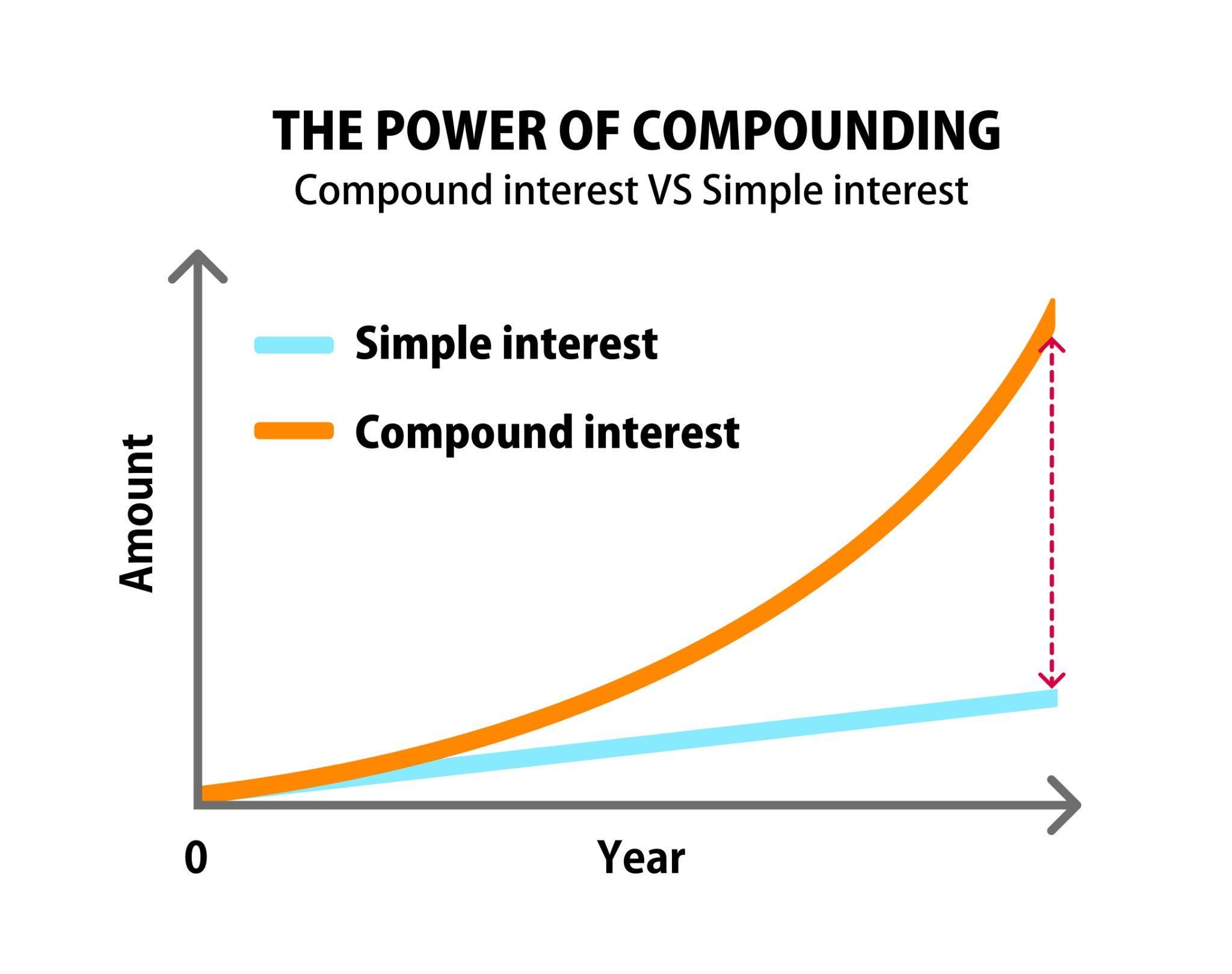
The principle of compound interest is illustrated above.
I am not going to deep dive further into this, I just wanted to show an example of exponential thinking.
Applying leverage to get ahead in your own life
Most people think too realistically about life. They don’t see that leverage can take you from a linear path and over to an exponential path.
Leverage comes in many forms, such as capital, technology, brand, network effects, and managing people.
Use them to your advantage to get ahead of linearity. You should take risks in life, and choose a career where you can apply leverage and compound interest. A typical 9-5 job with no equity compensation has a very limited upside.
Instead, try to start something on your own, join someone who has started something where you can get a flexible role in terms of your own career growth, equity compensation, and the possibility to use the skills you learn there in other fields or for your own startup later on.
In this modern world, I can’t think of a better way to apply leverage to the maximum than by starting your own personal brand. I’ve done it myself, and when I think back on my journey it’s absolutely amazing what I’ve created.
People read my thoughts because I am the one who is writing them. You want to learn about investing, crypto, and the latest yield opportunities from people with skin in the game, not from your PhD university professor.
Apply leverage in everything you do, and start thinking in years and how much your knowledge, skills, and mindset can compound due to exponential growth. Think bigger. Those who believe they can change the world will.
About taking risks and making asymmetric bets
I’d say you should dare to take big risks once you got some kind of basic needs met, I like the FIRE mindset for this (monthly expenses x 12 months x 25).
This number should be enough to live of the 4% rule, which means you can withdraw 4% from an stock market investment portfolio and never draw it down to zero (assuming 10% annual growth).
However, if you’re young and without much obligations and monthly expenses I think it makes sense to take risks without much money saved up.
Ask yourself what’s the worst that could happen? Most often the worst case is that you end up where you already are. On the other hand, if you take a risk you could 10x what you already have (this doesn’t only apply to money, but also skills and opportunities).
Aim for asymmetrical bets (see examples in my tweet below):
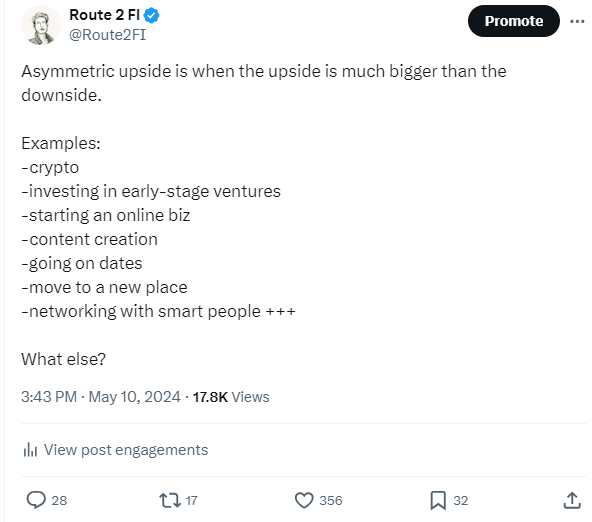
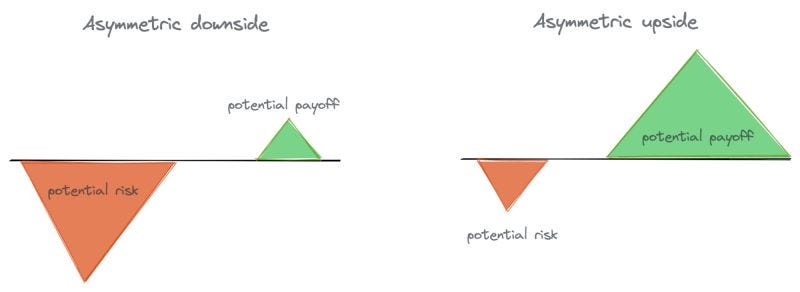
Asymmetrical bets to the upside are bets where the upside nets you 10-100x if you win, but you only lose small if you lose.
Stay away from risks that nets you a small payoff if you’re right, but a big potential risk if you’re wrong.
This is illustrated below.
Prioritize long-term gains (comes over years/decades) over short-term gains (the comfortable state of a monthly salary). By all means, surviving is important.
The problem is that many people get quite comfortable in their jobs, so the risk of trying something for a much bigger upside is getting less and less tempting due to the increasing salary.
The alternative cost is getting bigger (at least that’s how it feels like). However, the truth is that almost everyone (at least in the Western world), could go back to their current job or a similar alternative with the same salary if they failed at whatever new opportunity they tried.
Universal basic income to stimulate entrepreneurship
Getting off the hedonic treadmill will make you able to work on your true passion or calling in life. I read a book by Rutger Bregman called “Utopia for Realists” where he says that UBI (universal basic income) will stimulate to entrepreneurship and a lot of creative growth in a society.
The reason is simple really. Let’s say that everyone gets $3,000 paid out to their bank account every month. Let’s also assume that this is enough to live off, so that you don’t have to do any extra work to support your income.
A UBI would provide a sense of security for entrepreneurs. In some places where UBI was implemented, there was a 301 percent rise in entrepreneurship. There is data to show that for every 1 percentage point increase in the rate of entrepreneurship in a state, there is a 2 percent decline in the poverty rate.
One counter argument to UBI is that many people would end up lazy, depressed and do nothing. While this might be true, I believe most people would try to follow some kind of passion.
If that is by becoming an expert on video games, TV-series or creating startups, I believe that we would end up with a net positive effect of UBI and a lot more innovation than what we see today.
What do you really want in life?
You’ve probably heard the quote:
“Give me six hours to chop down a tree and I will spend the first four sharpening the axe.”
I am mentioning this quote because I think it is important when you stand in front of big decisions and in choosing what kind of work to focus on.
If you wonder what kind of work you should focus on in life, or what you should prioritize for the next year, it is much better to use some days and really map out a plan with actionable steps in complete silence, versus starting right away and go with the flow.

As the quote from Alice in Wonderland above, if you don’t know where you want to go, it doesn’t matter which direction you will take.
The point is just to spend some more time in life to think of what you really want to do in life. Most people could have created something beautiful, if only they believed in themselves.
I think in today’s social media society there’s a huge trend in watching reels and Tik Tok videos about how to improve life, however very few people act on these ideas. They watch the videos, but end up doing nothing about it. You may feel productive, but this is actually no better than watching a TV series. It’s just short-term dopamine.
Ask yourself if you do anything for your long-term growth at all, or if all activities you do are made up based on short-term pleasure (food, sex, sports, videos/music that makes you feel things, meeting girls, playing games, drugs, alcohol).
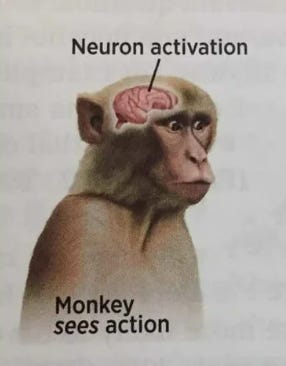
While there is nothing wrong with doing these activities, don’t make your life all about them. After all, you’re not a monkey. You’re able to delay gratification (think about the Marshmallow test experiment), but a monkey isn’t.
Examples of long-term activities (long-term pleasure):
learning a language
starting a business/small company
complete a marathon
earn a university degree
live in another country
writing a book
learning skills that might change your career
investing
losing weight
starting a personal brand
+++
Why becoming the best in a field is extremely rewarding
Another factor is that finding your ultimate purpose is extremely fun. When I worked 50-60 hour weeks in a corporate firm I hated my day-to-day basis, at first I thought it was because of the long hours.
But it wasn’t that. What I hated was to not work on something that didn’t impact my life. Today every hour I put in of work for Route2FI (yes, it is only me), will ultimately end up in some kind of reward. Well, not necessarily, but both the upside and downside belong to me.
This makes me extremely motivated to do a good job because no one else than me can make this a success story. If I don’t show up, the momentum I have will stall.
If you think about it, getting into becoming one of the 10% best in a field isn’t necessarily hard. You just have to spend a lot of time on it (working hard). But if you want to get into the 1-2% best, then you also have to work smart.
This is something I definitely should improve. Sometimes I think of how much more I could have scaled if I outsourced more, or completely abandoned writing tweets or newsletter posts.
However, I do really enjoy this. And at this point, it’s not about milking the most money out of the market or from partnership opportunities. I also do this because it gives me fulfillment. I am writing these words right now because I get pleasure from it. Writing is something I always will do and something that I don’t want to outsource.
Life is long, so dare to ask for what you want. Do not settle for less. This accounts for both your career, your partner, and your friends. If you want to be lucky in life, you need to set yourself up for luck to find you. The funny thing is that luck often finds you when you are working hard for it.
Stop for a few seconds and reflect on this question:
“What do I want in life?”
Chances are you will answer something that you don’t have or something that you miss today. But let me ask you this.
How much are you working to get the things that you want? How many hours do you put in? You want to create a successful Tik Tok brand, but haven’t started yet because you feel it is too saturated?
Most people postpone starting, or actually never start something at all because they don’t set baby steps. They just think about the end goal, and conclude that it will be impossible to go there without even trying.
Get specific knowledge
Naval says you need specific knowledge. Specific knowledge is the knowledge that only you have. The easiest way to create this is to have a personal brand. As I mentioned earlier. People read my thoughts because I am the one writing them.
We could send this text to an unknown Twitter account, and it wouldn’t have gotten many views. Not because the text wasn’t good enough, but because they have no followers. However, if you repeat this exercise (publishing week after week for years), the right tribe will find you.
This is something I am good at, to be consistent. I know I am not the best writer. I know that if I spent more time on editing, making better graphics, having people who give me feedback before I publish, etc., my texts could be even better. But instead of doing something perfect, I publish it at 80-90%.
For me, this is the only way to get things done. And over time, I am quite happy about this. I am proud to look back on over 100s of articles here. Maybe I’d only manage to do 25% of the amount if I were too perfectionistic about it.
Get specific knowledge. Dare to post weird takes. Some people out there will like your unique style. Define yourself by your strengths, not your weaknesses. Imagine how good you can be if you only focus on your strengths.
You can be the top 1% in a field. Instead of improving your sales skills from 45 to 50% (just a random example, but my point is just that to become one of the best you should focus on what you are naturally talented at).
Make sure to get to a point where you have enough money to make decisions based on what you really want to do instead of making these decisions because you are desperate after money.
Because in my opinion, the best thing you can work on is when you have internal motivation to do it. And yes, you can have a high amount of internal motivation doing normal jobs, but most people would quit it if the employer stopped paying.
A good test to see if you are doing something you are fully purposed to, is to ask yourself: what would I do if money were no object?
You can see the video below from Alan Watts.
This inspired me a lot 10 years ago:
It's difficult to do well on work that you don't care about.
Furthermore, having a job you dislike makes it difficult to be completely content with your life. Try to be the greatest in whatever you do for a living. Be brave and take some chances in life, particularly at the beginning of your career or in your 20s.
Make an effort to associate with those who are among the world's greatest at what they do (for me, I met these people on Twitter, and I am happy to have met many of them in real life too).
Think about it this way, chances that your friends are as genuinely interested in a particular topic as you are, is quite small, however, on Twitter, there are thousands of people who dive deep into the same rabbit holes as you do.
Find them, and make them your friends.
Trust me it will be worth it.
…
I will stop for now.
Let me know if you liked the post and if I should share more content like this.
See you around, anon.
Great read again. God bless you brother. You’re such an inspiration to me. Thank you !!